Readers Question: Is the fiscal policy effective/the best policy to deal with unemployment?
It is an interesting question and one that is likely to generate different views from within the ranks of economists.
To give a very rough overview:
In a recession, we see a rise in unemployment as firms lay off workers.
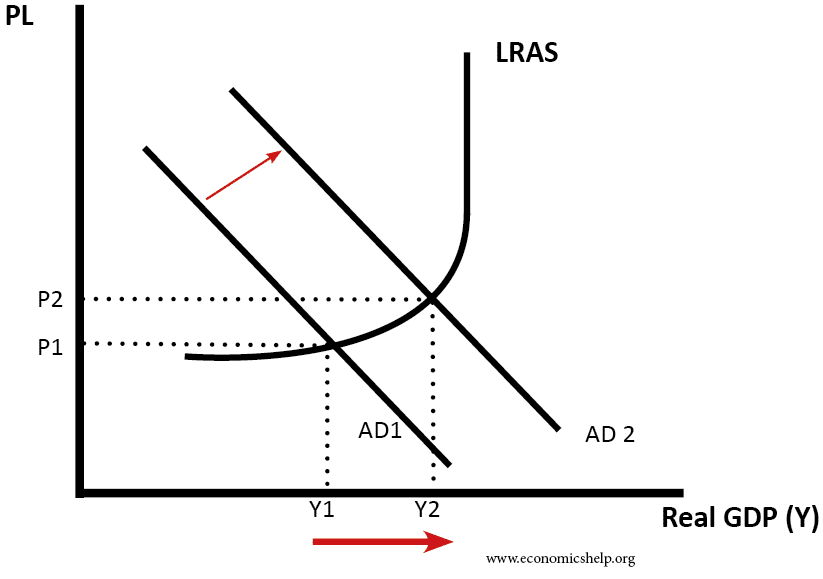
In this situation, the government can usually borrow from the private sector at a relatively low cost of borrowing. The government can spend money on infrastructure projects. This injects money and spending into the circular flow – causing a rise in aggregate demand.
Fiscal policy (cutting taxes and/or increasing spending) can lead to an increase in AD and rise in real GDP.
The increase in economic growth will cause increased demand for workers, providing employment and reducing unemployment.
Fiscal policy cannot solve supply-side unemployment. (the natural rate)
If there is frictional or structural unemployment, fiscal policy will not solve this. For example, suppose some former miners are unemployed. The problem here is lack of skills and geographical immobilities. Therefore, what is needed is supply-side policies. Increasing AD and economic growth does not solve the mismatch of skills. Therefore, when the economy is at full capacity, classical economists are correct. If the economy is growing and the government pursue fiscal policy, it is likely to be ineffective in reducing unemployment.
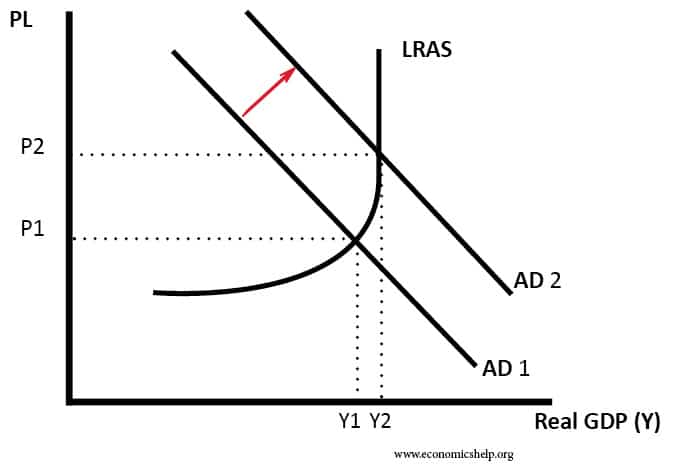
(Impact of fiscal policy, if the economy is at full employment.)
However, despite these limitations, it can play a role in increasing AD and reducing cyclical unemployment.
In February 2009, Congress approved President Obama’s $787 billion American Recovery and Reinvestment Act. This was a package of tax cuts and spending increases – financed by higher borrowing. It involved tax cuts of $288 billion. Extended unemployment benefits of $213 and $275 billion in federal contracts, grants, and loans. The package wasn’t implemented immediately and took several months for the higher spending to be spread throughout the economy. The government also approved a bailout of the automobile industry which helped avoid job losses in that sector.
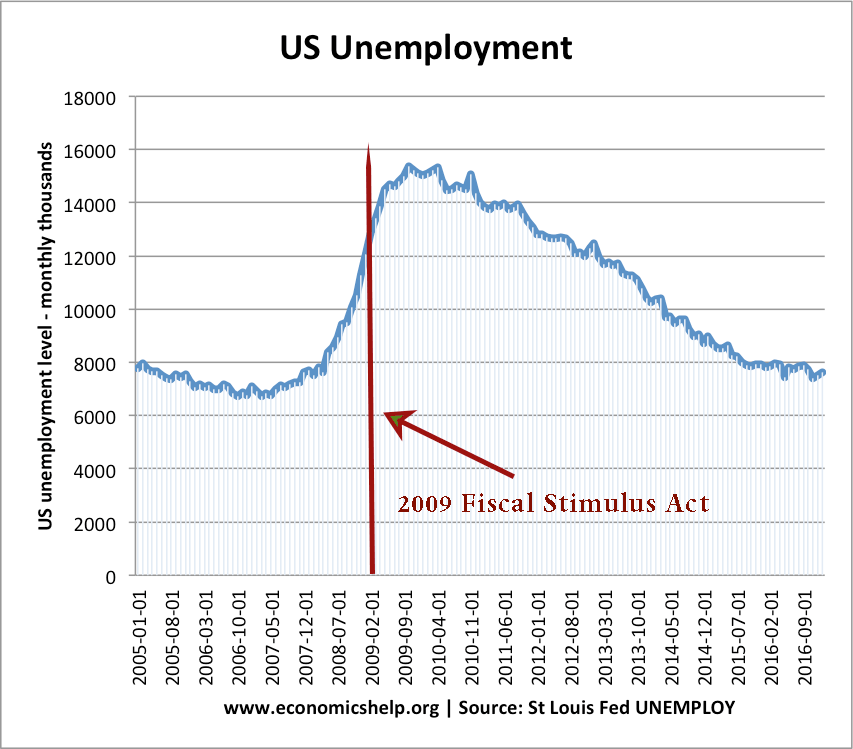
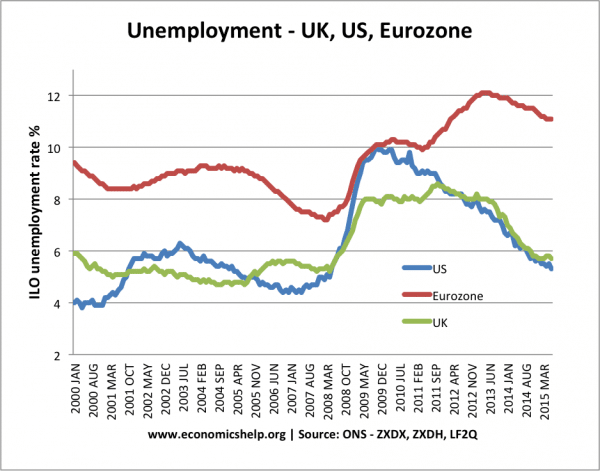
Given the time lags involved, the package was successful in limiting the scope of the 2009 recession and creating an economic recovery. As a result of the economic recovery, unemployment fell at the end of 2009 and consistently fell into 2017.
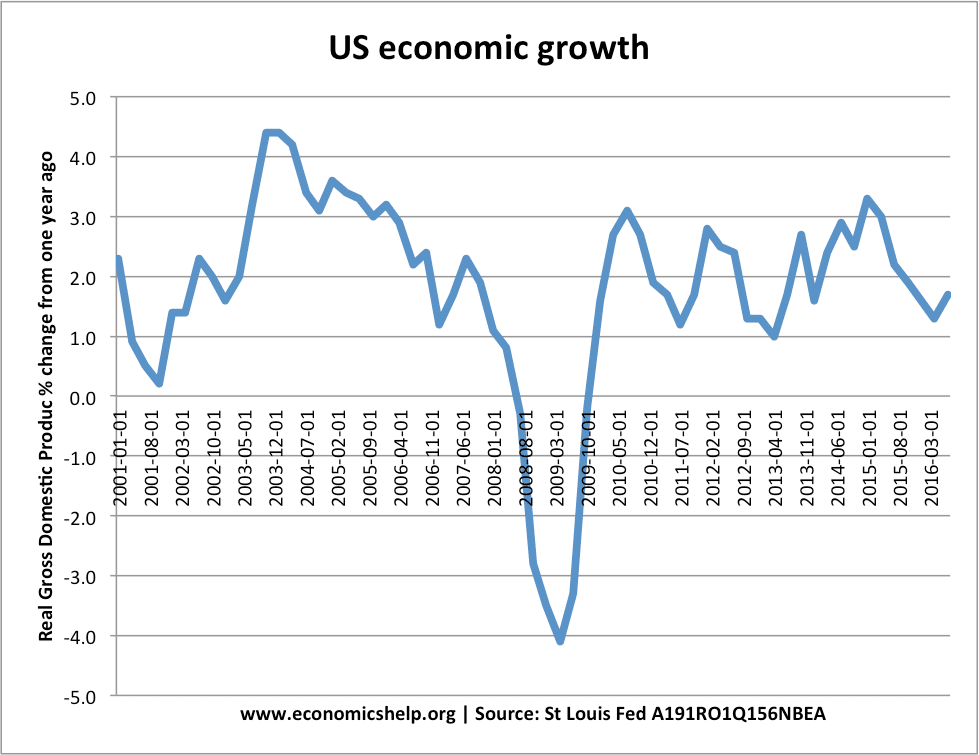
Strong recovery in the US.
Limitations of fiscal policy
However, compared to the Eurozone – which didn’t pursue expansionary fiscal policy, the US recovery was stronger.
Also, some economist such as John Taylor of Stanford, and Eugene Fama of the University of Chicago were more suspicious of fiscal policy arguing it leads to higher borrowing costs, crowding out and just ends up with higher government borrowing. However, despite the rise in US borrowing, bond yields fell during this periods, and the budget deficit fell with the economic recovery.
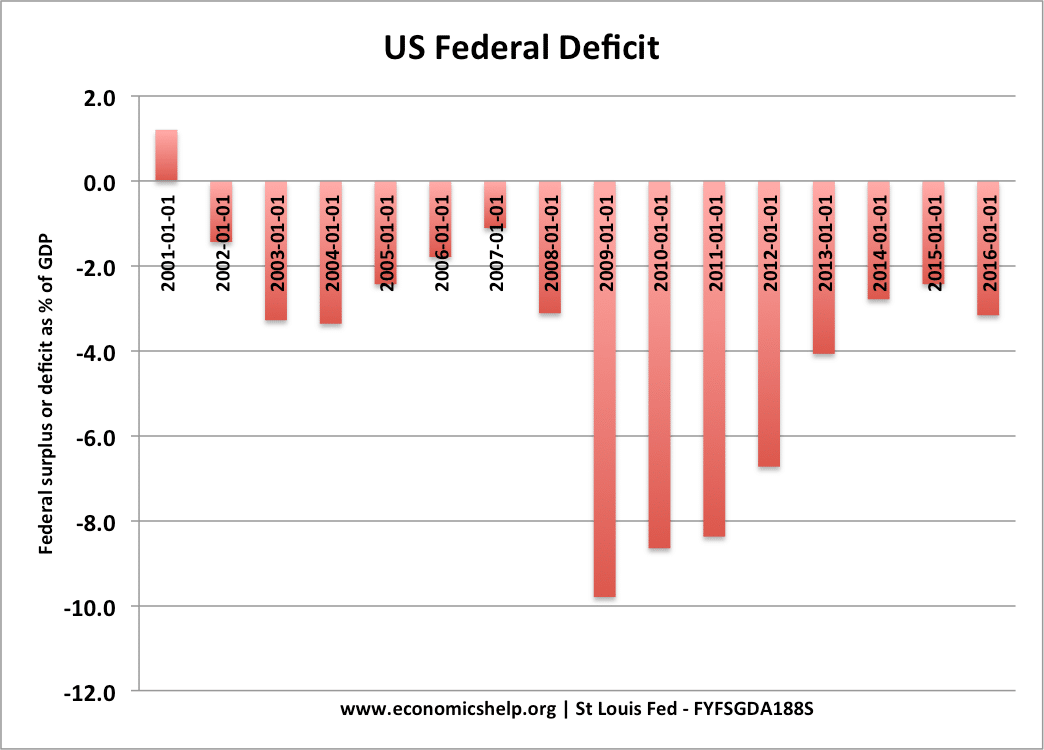
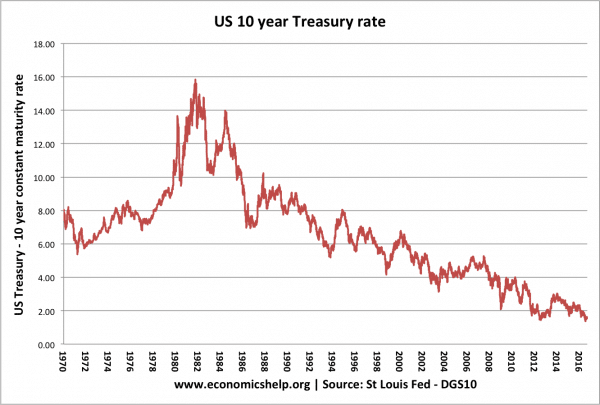
Higher debt did not cause higher bond yields but falling bond yields, suggesting there was strong demand for buying government debt.
Related
